

On World Aquatic Animal Day (3 April 2025), ICARE launched the first seminar of our new Litigating and Legislating for Animal Rights seminar series with a deeply thought-provoking discussion featuring Giulia Malerbi, Head of Global Policy at the Aquatic Life Institute, and moderated by Dr Paulina Siemieniec, specialist in animal philosophy, law, and politics.
The seminars are held bi-monthly and bring together leading animal advocates in a conversation format to explore the role of litigation, legislative reform, and political advocacy in advancing animal rights, through knowledge and experience sharing, case studies, and real-world challenges.
Our conversation with Giulia Malerbi, this World Aquatic Animal Day, focused on the growing movement to preemptively ban octopus farming—before it becomes another entrenched system of animal suffering.
A full transcript and the recording of the seminar are available for those who wish to explore further.
Introducing the Issue: Why Octopuses Matter
Our moderator, Dr Paulina Siemieniec, opened the seminar by highlighting the extraordinary nature of octopuses:
“Octopuses have three hearts, zero bones, blue blood, sophisticated nervous systems and large ring-shaped brains. [...] On the underside of each of their arms, they have highly sensitive suckers that are independent from their central brain but contain clusters of neurons that act as sort of small brains to execute certain functions.”
She further explained their behavioural richness, noting:
“Their intelligence is also demonstrated through their cognitive and behavioural complexity, including their ability to use tools, solve puzzles, recognise individual humans, play, change the colour and texture of their skin to match their surroundings and hunt in cooperation with fish."
Beyond their biological marvels, octopuses lead solitary, complex lives. Farming them would require removing them from their rich natural environments and confining them in barren, restrictive tanks.
As Giulia Malerbi explained:
“Farming these animals basically means removing them from the context that we just discussed, and placing them in small, barren tanks. And this could mean placing them either, like, alone, which in the case of octopuses, means chronic boredom and stress, or the opposite, which is, grouped together, which often can result in aggression and cannibalism.”
A Structural Ethical Concern: Why Octopus Farming Is Wrong
The ethical opposition to octopus farming goes deeper than the extraordinary traits of octopuses themselves. As Malerbi framed it:
“We believe octopus farming is unethical for the same reason that we oppose factory farming more broadly, because it causes immense suffering. It forces sentient, intelligent animals into systems that just deny these animals the ability to live and thrive in a way that reflects their nature.”
Importantly, she emphasised:
“I don't believe that their fascinating qualities make them somehow better than other animals.”
Rather, it is their sentience, and the suffering imposed by intensive farming, that grounds the moral and legal imperative to act.
Siemieniec drew an important connection between the octopus farming debate and broader critiques of factory farming:
“The arguments that octopuses are highly intelligent and would suffer so much in captivity for a number of reasons apply to many land animals that we’re factory farming, like pigs.”
However, as she noted—echoing experts such as Dr Elena Lara — unlike pigs, octopuses remain wild animals, and:
“[...] we do not have the same knowledge about octopuses, who are wild and thus we lack even the insight to know what it would mean to ‘improve their welfare’ in farming them.”
Thus, octopus farming raises not only welfare concerns but profound questions about human ignorance and the ethics of bringing wild species into captivity.
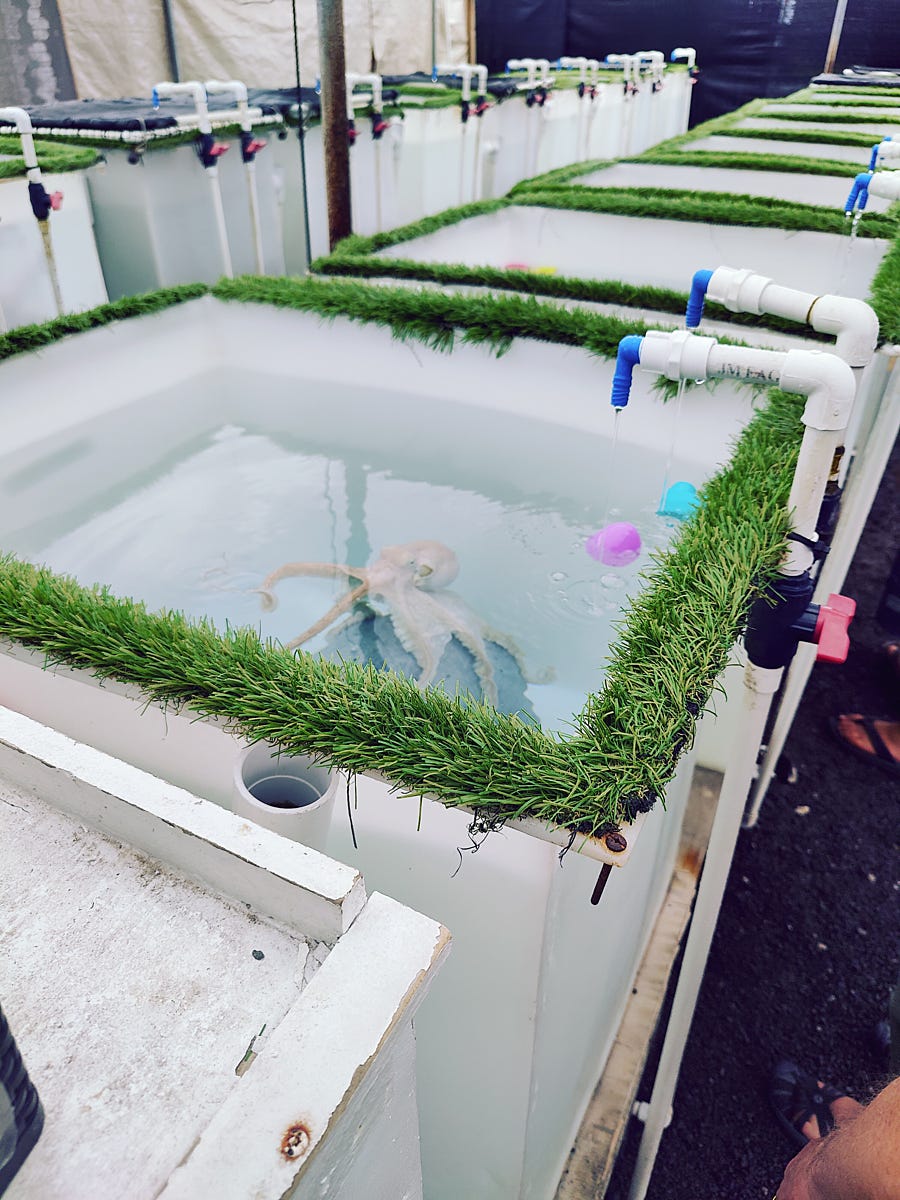
Why Octopus Farming Is a Bad Idea — For Animals and the Planet
Octopus farming is often framed as a solution to food security. But as Malerbi warned:
“In reality, it is really being driven by market forces.”
Wild octopus populations have been heavily overfished—their catch skyrocketing from 30,000 tons in 1950 to 350,000 tons today—but farming octopuses is no real solution. It compounds welfare, environmental, and sustainability problems:
Animal Welfare: Octopuses fail across all five pillars of aquatic animal welfare developed by the Aquatic Life Institute—environmental enrichment, feed composition, stocking density and space, water quality, and slaughter method.
Environmental Impact: Farming carnivorous species like octopuses requires feeding them wild-caught fish.
“In order to have one kilogram of octopus ‘meat,’ you need to invest or feed these animals three kilograms of marine life.”
Public Health Risks: Octopus immune systems are poorly understood, and there are no veterinary protocols for disease prevention in farmed octopuses.
As Malerbi summed up:
“Honestly, the reason why we’re talking about octopus farming today is because the industry found some attractive characteristics of these animals. [...] But, of course, in our view, they really don’t offset the welfare harms.”
Methods of Killing: A Critical Welfare Crisis
One particularly disturbing aspect is the lack of ‘humane’ slaughter methods. Malerbi described the main technique being proposed:
“The default approach has been the use of ice slurry [...] where octopuses are submerged in a bath of ice and water until they die because of lack of oxygen.”
This method causes prolonged suffering:
“Several studies have demonstrated that octopuses that are subjected to ice slurry do remain conscious and can even stay responsive for several minutes.”
She noted that even the European Food Safety Authority has warned against using ice slurry for farmed fish—raising serious concerns about expanding such practices to octopuses.
The Myth of 'Sustainable' Octopus Farming
Industry narratives often claim that farming octopuses could be sustainable. Malerbi responded bluntly:
“I can answer very short. No! I don't believe that octopus farming can ever be made sustainable.”
Farmed octopuses would primarily supply luxury markets—not food-insecure populations. As Malerbi cited:
“Farmed octopus would not be destined for communities that are facing food insecurity. They would go to fancy restaurants [...] where octopus is really not a nutritional necessity.”
Moreover, farming octopuses would intensify pressure on wild fish stocks—precisely the opposite of what “sustainability” requires.
Legislative Momentum: Recognising Sentience and Preventing Harm
One of the most hopeful developments is the growing legal recognition of aquatic animal sentience. As Malerbi noted:
“Once the laws recognise that, an animal’s capacity to suffer, to experience emotions, to interact with the environment, it should become, at least, harder, you know, to justify systems that so clearly cause harm and that would be preventable.”
Siemieniec added an important legal insight:
“It seems like the legal recognition of sentience would essentially be meaningless if there was no practical effect of actually protecting animals like octopuses.”
Recognition of octopus sentience in places like the UK and New Zealand creates new opportunities—but it must be translated into tangible protections.
Despite the alarming developments, particularly in Spain, in the United States, legislative momentum is already building:
Washington State was the first state to pass a ban, signed into law in March 2024, followed by California in October 2024.
Other states including New Jersey, Connecticut, Hawaii (where the Kanaloa Octopus Farm was shut down for illegal wild captures), Oregon, and North Carolina (in March 2025), have introduced bills.
At the federal level, the OCTOPUS Act was introduced in July 2024 to ban octopus farming nationwide.
Malerbi celebrated this trend:
“Many of these efforts are bipartisan. And they are rooted in the clear recognition that octopus farming is ethically indefensible, environmentally unsound, and simply unnecessary.”
As Malerbi explained, what makes this moment unique is the chance to act proactively:
“With octopuses, the difference is that we have, on the legal point of view, sort of the chance to reverse this timeline, so we can use legal recognition as a proactive tool to prevent the establishment of a new industry.”
Why Preemptive Action Matters
Some ask why to focus so much energy on octopuses when billions of land animals already suffer in factory farms. Malerbi offered a compelling strategic perspective:
“We still have time to stop it, right? There is a very rare moment where there’s no entrenched infrastructure. [...] Imagine if, at the time [70 years ago], we managed to successfully challenge the breeding of fast-growing chickens. Imagine today we would be in a very, very different place.”
Preventing octopus farming is a chance to do things differently—to avoid replicating past mistakes.
Building a Different Future: The Aquatic Life Institute’s Vision
Malerbi closed by sharing the Aquatic Life Institute’s broader framework for transforming aquatic food systems, known as the ‘4Rs’:
Reduce the number of animals used in aquatic food systems.
Refine existing practices to improve aquatic animal welfare.
Replace animal-based aquatic products with plant-based or cultivated alternatives.
Reject the introduction of new species into farming systems—such as octopuses.
As she eloquently stated:
“This campaign fits within Aquatic Life Institute, our broader theory of change. [...] Octopuses have helped us, like, ‘bridge the empathy gap.’ Once people really understand why farming octopuses is wrong, they are more open to questioning other accepted practices.”
Siemieniec concluded by framing the broader structural importance of the issue:
“The suffering of farmed octopus is exposing deeper structural problems in the way that aquatic food production is being approached generally.”
How You Can Help
Anyone can help prevent octopus farming:
Get informed: Read and share resources.
Raise awareness: Watch My Octopus Teacher or read The Soul of an Octopus to understand these animals better.
Sign petitions: Such as the Avaaz petition, which has already gathered over a million signatures.
Support legislative efforts: Advocate with your local representatives.
As Malerbi encouraged:
“Every action really does make a difference.”
🔗 Watch the Full Recording on ICARE’s YouTube channel (and subscribe!)
We are very grateful to Giulia Malerbi for this conversation and the Aquatic Life Institute and their allies for their important work on this issue, and to Dr Paulina Siemieniec for her questions, insights and excellent work in moderating this seminar. We’re already looking forward to the next one in June!
Thank you to all of you who attended or will watch the recording. We look forward to your feedback and to having you engage with the seminar series!