


On 23 June 2025, ICARE’s Litigating and Legislating for Animal Rights seminar series turned its focus to one of the most systematically exploited yet legally underprotected groups of animals: chickens and hens.
Moderated by Dr Paulina Siemieniec, the conversation brought together Edie Bowles, solicitor and Managing Director of Advocates for Animals | Solicitors and Founder and Executive Director of the Animal Law Foundation (UK), and Kathryn Evans, Staff Attorney at Legal Impact for Chickens (US).
The discussion provided a transatlantic view of how strategic litigation can be used to enforce — and sometimes expand — protections for these animals.
You can access the full transcript here.
Why Chickens and Hens Are Left Behind
Kathryn began by outlining the stark statistics from the US:
About 95% of the land animals killed for human consumption in the US are chickens raised for meat. If you add in ‘egg-laying’ hens, ducks, turkeys, other birds, it's 98% of land animals slaughtered in the US.1
Despite this overwhelming proportion, US federal protections only regulate how farmed animals are treated at slaughter, and for farmed birds, the protections are minimal.2 Kathryn explained:
…basically, you can’t handle birds in a way that causes excessive bruising, and you have to kill the bird by…a knife cut to the throat…
Outside of slaughter, most protections come from state laws — and those vary widely.3 Some states ban cages for laying hens, others do not. Crucially, most state anti-cruelty statutes contain exemptions for “customary farming practices” or “common animal husbandry practices”.4
Edie noted similar patterns in the UK, notably that chickens are also the most farmed animals in the UK, but while legislation like the Welfare of Farmed Animals Regulations provides some welfare standards on the farm, enforcement is weak, and their suffering is hidden from sight:
I think in the UK context, the issue is probably more that you can farm an animal in these atrocious conditions…in a huge shed with tens of thousands of other animals closely packed together…they tend to be farmed inside…outside of kind of public view…there's a huge issue with the oversight and the application of the laws, so whilst they do have some legal protections and a comparable amount of legal protections to other farmed animals…the fact that you can farm them in such huge numbers, and in such cramped conditions as to why we see them being treated the way that they are.
The Animal Law Foundation’s “The Enforcement Problem” joint report found that between 2022 and 2023, only 2.5% of more than 300,000 farms across England, Scotland, and Wales were inspected at least once, and although 22% of those inspections identified non-compliance with animal welfare law, fewer than 1% resulted in prosecutions.5 This systemic under-enforcement undermines legal safeguards intended to prevent ‘unnecessary suffering’ among farmed animals.
Litigation as a Tool: UK Case Studies
Edie discussed how UK litigation often targets government failures to enforce existing law, citing the Frankenchicken judicial review.6 This high-profile case challenged the legality of keeping fast-growing chicken breeds — commonly known as “Frankenchickens” — bred to reach slaughter weight in just 34–36 days, and which are associated with severe welfare problems. The case turned on the interpretation of the Welfare of Farmed Animals (England) Regulations 2007, specifically the provision that prohibits keeping animals whose genotype or phenotype makes it unlikely they can be reared without detriment to health or welfare.7
Frankenchickens are fast-growing chickens, chickens that have been selectively bred to reach slaughter weight, which is around 2.2 kilograms, within five to six weeks. And as a result of this fast growth…they suffer from a range of health and welfare issues, from organ failure, broken legs, as a result of broken legs sitting within their own kind of waste and getting burns over their body…it's a really detrimental breeding practice.
Edie explained:
The case…was a challenge against the government over the, essentially, the keeping of these animals, arguing that it's unlawful to keep them. There is no specific legal provision that says that a Frankenchicken a fast-growing chicken, is illegal. However, there is a legal provision that says you can't keep an animal for farming purposes if, on the basis of their genetics, they're prone to detriment to their health or welfare…our client…The Humane League argued essentially that, of course, this applies to fast-growing chickens.
She commented about the results:
The case was a kind of a mixed bag in terms of the results. So we were unsuccessful arguing against the government for the keeping of these animals,…largely on a technicality,…there wasn't a hook really for the court to say…the government's behaved unlawfully. However, the court did provide a legal interpretation for…what this provision means…about keeping animals prone to detriment for their health and welfare. And it's our client's position that this would…render fast-growing chickens illegal…however, if we wanted to be successful in that, we would have to go to the criminal courts and argue against an individual keeper of these birds.
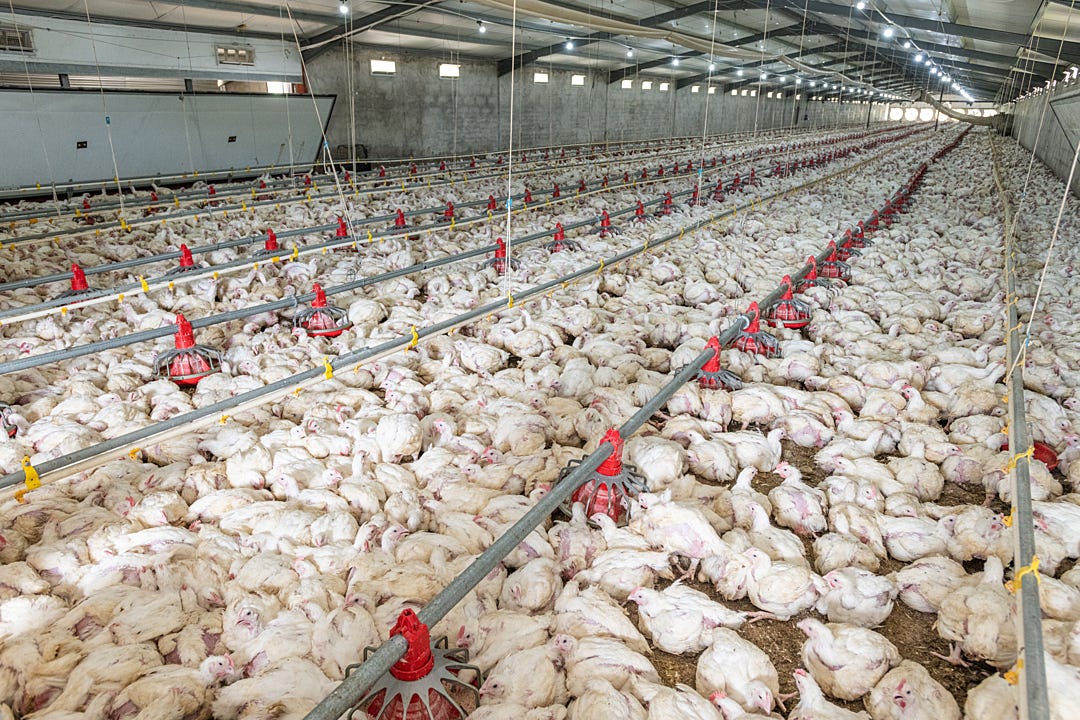
Thirty-three thousand chickens raised for meat live tightly packed together, cramped inside a massive shed on an industrial broiler chicken farm. The farm has slated these 33-day-old chickens to be rounded up for slaughter that evening. Sub-Saharan Africa, 2022. Jo-Anne McArthur / Sibanye Trust / We Animals
Edie commented about extending this logic to other animals:
…the provision that I'm referring to is in the Welfare of Farmed Animals Regulations. So it applies to any farmed animal kept for various things, food, wool, and I think ‘other products’ is the definition…if another animal is being kept that has genes that mean that they're prone to detriment, then absolutely this provision could apply…There's still work to be done…we do have a provision that is favourable to protect animals from this problematic breeding.
Alongside the Frankenchicken judicial review, she highlighted an ongoing High Court judicial review brought by the Animal Law Foundation challenging recent government changes to chicken handling rules.8 The Animal Law Foundation has been granted permission by the High Court to pursue a judicial review, challenging both the process by which this change was consulted upon and the substance of the amendment itself.
Historically, UK law — aligned with retained EU Regulation 1/2005 on the protection of animals during transport, transposed in The Welfare of Animals (Transport) (England) Order 2006 — prohibited lifting chickens by both legs, a practice associated with high stress, injury, and mortality rates.9 In July 2025, however, the government introduced a statutory amendment to permit the catching of chickens by both legs.10 This change, set to take effect on 22 July 2025, effectively legalises a handling method long criticised by veterinarians and welfare organisations for its very detrimental impact on bird welfare.
As Edie explained, the case raises fundamental questions about the adequacy of government consultation, the weight given to independent animal welfare science, and the broader post-Brexit trajectory of UK farmed animal protections.
These cases demonstrate that strategic litigation can have an impact even without delivering a complete legal victory. As with Frankenchicken, Edie noted, court proceedings can elevate an issue to the political agenda, attract media attention, and mobilise public debate — outcomes that can be as important for animal advocacy as the judgment itself.
US Approaches: Private Enforcement and Corporate Accountability
Kathryn outlined Legal Impact for Chickens’ strategy of using existing cruelty laws against large corporations. One prominent example is Smith v. Vachris, a shareholder derivative lawsuit filed by Legal Impact for Chickens on behalf of two Costco shareholders. The suit alleges Costco executives violated Nebraska and Iowa livestock neglect laws by knowingly raising chickens so large they couldn’t stand, leading to suffering, injury, and abandonment—claims that breach fiduciary duty and underscore systemic corporate cruelty.11
A derivative shareholder lawsuit, she explained, is a legal action brought by shareholders on behalf of a corporation against its executives or board members for failing in their duties to the company. In this case, the claim was that Costco’s executives had breached their fiduciary duties by permitting animal cruelty that could expose the company to legal and reputational risks.
…a lot of the birds were dying very slow and painful deaths because they grew so big they couldn't walk, or they had other issues that prevented them from moving, so they couldn't access food and water, and they were not being humanely euthanised. They were just being left to die…Costco's leadership actually responded to the investigation and said this is normal activity on farms…so that was evidence that leadership knew this was happening, they weren't going to change anything about the practices…So, LIC represented Costco shareholders who said you are violating the state laws by not providing all of your chickens with adequate food and water, and the board is clearly not going to do anything to fix these violations.
Kathryn also explained:
Shareholder litigation is really just another tool to try to make companies follow the law…it is really focusing on the company and the leadership and the systems that are in place, and that are allowing these abuses to happen instead of focusing on like one farm or particular workers who are kind of caught up in this system and really forced within the system that if they want to keep their jobs, they have to sort of perpetuate the abuses.
Private enforcement is often necessary in the US, where political and economic pressures can stifle regulatory action. Civil litigation can compel change through settlements, court orders, and the reputational pressure of discovery and trial.
Challenges in Court
Both addressed the hurdles inherent in litigating for chickens and hens. Kathryn highlighted procedural barriers, such as standing:
…animal law is always a tough area of law because animals themselves don't have standing. They can't bring a lawsuit on their own behalf. And so animal law cases are often framed in terms of how humans are injured by abuse to animals, and LIC is always looking for ways to…centre what's actually happening to animals.
Evidence gathering is also a major challenge:
…we see a lot of people who are just afraid to speak up or who want to report to us, but they want to remain anonymous…unfortunately, in the U.S. legal system, it's very hard to keep your sources of information anonymous because the defendant has rights to know where your information is coming from and to also question those people.
Kathryn added:
As far as ag-gag laws, there are a few that still remain in the U.S., so these say it's illegal to film on a farm or to otherwise collect information from farms without the owner's permission. A lot of them have been struck down as unconstitutional because we have free speech rights that protect things like making videos and speaking about what you see on farms.
Maximising Advocacy Impact
The conversation repeatedly returned to the idea that litigation is not just about the court ruling. Kathryn described media work as an essential parallel track:
…there was a big…New York Times article about the case, we read a lot of anecdotes about people…learning how Costco… has its own subsidiary with these farms to grow rotisserie chickens that they sell for, I believe, $4.99…and they lose money on this product. And so that's partially why the conditions on the farms are so bad…because they're trying to keep the product so cheap. And so getting news out there that the products were so cheap, because the chickens were being treated so poorly. There was like one person who ran a Facebook page specifically for fans of Costco, like shut down her Facebook page, because she found out how bad the conditions were for the chickens.
Edie emphasised coalition-building and aligning legal actions with broader campaigns:
It's exciting to take the government to court, and it's very newsworthy…there's these real benefits of…a legal challenge for campaigning and for advocacy purposes that I really think my client, The Humane League, maximised and got the message across. Now, of course, it's all through a very, very legitimate, credible case…The Humane League was also able to package that up and communicate it to the public…I think the case was instrumental in public awareness over these birds; and if that doesn't kind of indicate how impactful legal advocacy can be, then I'm not sure what would.
Key Lessons for Advocates and Practitioners
From their combined experience, Edie and Kathryn offered several takeaways for those considering strategic litigation for chickens and hens:
Know Your Legal Landscape – Understand the gaps, exemptions, and procedural rules before filing.
Use Multiple Angles – Pair litigation with media advocacy, campaigns, and public education.
Be Prepared for Partial Wins – Even an unfavourable ruling can be a platform for change and raising awareness.
Build Strong Evidence Files – The credibility and impact of a case often hinge on robust, admissible evidence.
Collaborate Across Sectors – NGOs, lawyers, investigators, and campaigners each bring essential strengths.
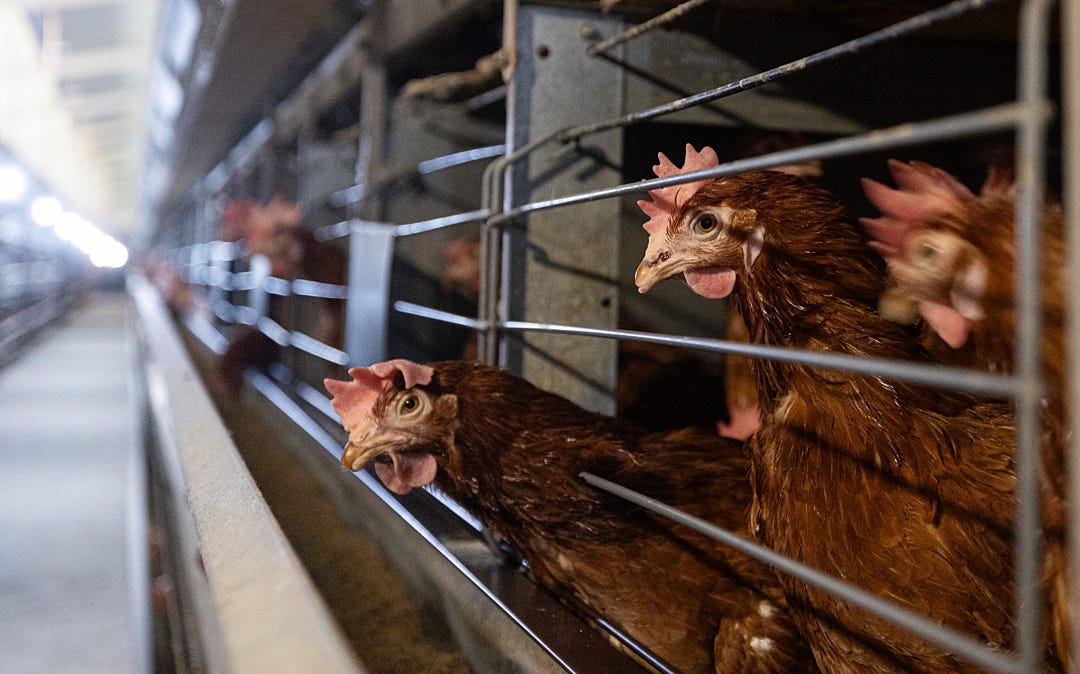
Confined laying hens curiously peer out from a cage in a battery system stretching dozens of metres long on an industrial farm. The hens share each cage with several others, each bird allocated a space roughly the size of an A4 sheet of paper. Portugal, 2023. Andrew Skowron / We Animals
Conclusion
Strategic litigation for chickens and hens is both challenging and vital. While the legal systems in the UK and US differ, this seminar revealed striking commonalities: entrenched exemptions, limited enforcement, and the need for creative, multi-pronged approaches.
Litigation is one tool in the toolbox. Used well, it can be a powerful catalyst for change. These animals need us to use every lawful avenue to make their lives better and end their suffering — and to hold those responsible for cruelty accountable.
📺 The full recording of this seminar is available on ICARE’s YouTube channel to learn more from both our invitees, their strategies, case studies, the legal landscape, and insights shared.
Thank you very much once again to Edie Bowles and Kathryn Evans for their kind participation and generously sharing their expertise and experiences with us — we learned so much from them! We hope you enjoyed this conversation and the seminar series, and appreciate reading these takeaways. You can watch the past episodes in this series in our playlist on ICARE’s YouTube channel or find them on the seminar series page on ICARE’s website.
Thank you also to all of you who attended or will watch the recording. We look forward to your feedback and to welcoming you to the next seminar! If you like it, you can support our work with a donation.
U.S. Dep’t of Agric., Nat’l Agric. Stat. Serv., Poultry Slaughter 2020 Summary (Feb. 26, 2021), https://downloads.usda.library.cornell.edu/usda-esmis/files/pg15bd88s/f1882d39g/j6731z19s/pslaan21.pdf; U.S. Dep’t of Agric., Nat’l Agric. Stat. Serv., Livestock Slaughter 2020 Summary (Apr. 21, 2021), https://downloads.usda.library.cornell.edu/usda-esmis/files/r207tp32d/sj139x554/7w62g4561/lsan0421.pdf.
See Humane Methods of Slaughter Act, 7 U.S.C. §§ 1901–07 (2025) (covering only livestock, not including poultry); cf. Poultry Products Inspection Act, 21 U.S.C. §§ 451–472 (2025); 9 C.F.R. § 381.65(b) (2025) (requiring poultry to be slaughtered in accordance with “good commercial practices” to avoid carcass contamination); see also U.S. Dep’t of Agric., Food Safety & Inspection Serv., Humane Handling for Livestock/GCP in Poultry, at 1 (Oct. 1, 2021), https://www.fsis.usda.gov/sites/default/files/media_file/2021-11/21_IM_Humane-Handling-GCP-10012021.pdf (noting that “HMSA of 1978 does not cover poultry” and that poultry handling is regulated under “good commercial practices” via the Poultry Products Inspection Act, rather than HMSA).
See Animal Welfare Act, 7 U.S.C. § 2132(g)(3) (2025) (defining “animal” but excluding “other farm animals, such as, but not limited to livestock or poultry, used or intended for use as food or fibre”); Anti‑Cruelty: Related Statutes, Animal Legal & Hist. Ctr., https://www.animallaw.info/statutes/topic/anti-cruelty (last visited Aug. 13, 2025) (compiling state cruelty laws, which vary widely in scope and exemptions).
See Legal Protections for Animals on Farms, Animal Welfare Inst., at tbl.1 (noting that in 37 states, “common or recognized animal husbandry practices”—including tail docking and castration without anaesthesia—are exempt from cruelty definitions), https://awionline.org/sites/default/files/uploads/documents/22-Legal-Protections-Farm.pdf (last visited Aug. 13, 2025).
Animal Law Foundation & Animal Equality, The Enforcement Problem: How Farmed Animal Welfare Laws Are Under-Enforced in the UK 2 (2024), https://animallawfoundation.org/app/uploads/2022/10/Report_The-Enforcement-Problem-in-the-UK.pdf
R (Humane League UK) v Secretary of State for Environment, Food & Rural Affairs, [2024] EWCA (unreported), judgment approved by the court for handing down (Dec. 2024), para. 24 (available at Judiciary.uk); see also “'Frankenchickens' judgement 'seismic for billions of birds’,” The Ecologist (Dec. 13, 2024) (stating the Court’s view that farming animals that suffer due to their genetics is “very likely unlawful”).
See Welfare of Farmed Animals (England) Regs. 2007, Sch. 1 ¶ 29 (“Animals may only be kept for farming purposes if it can reasonably be expected, on the basis of their genotype or phenotype, that they can be kept without any detrimental effect on their health or welfare”); see also “‘Frankenchicken’ Farming in England Against Animal Welfare Law, High Court Told,” The Guardian (May 3, 2023) (noting claim that fast-growing broiler chickens reach slaughter weight in about 34–36 days and experience serious welfare challenges), https://www.theguardian.com/world/2023/may/03/frankenchicken-farming-in-england-against-animal-welfare-law-high-court-told.
Animal Law Foundation, Chicken Handling (2025), https://animallawfoundation.org/chicken-handling (“This is the first dilution of animal welfare legislation post-Brexit... We were given permission to proceed with the judicial review by the High Court in July. The judge also gave us permission to amend our grounds to challenge the lawfulness of the consultation and change in law to permit the handling of chickens by their legs.”).
Delanglez, F., Watteyn, A., Ampe, B., Segers, V., Garmyn, A., Delezie, E., Sleeckx, N., Kempen, I., Demaître, N., Van Meirhaeghe, H., Antonissen, G., & Tuyttens, F. A. M. (2024). Upright versus inverted catching and crating end-of-lay hens: a trade-off between animal welfare, ergonomic and financial concerns, 103 Poultry Science 104118. https://doi.org/10.1016/j.psj.2024.104118
See Welfare of Animals (Transport) (Amendment) Regulations 2025, SI 2025/776, made Jun. 30, 2025, laid before Parliament Jul. 1, 2025, commencing Jul. 22, 2025 (amending retained Reg. 1/2005 to exempt chickens and turkeys ≤ 5 kg from leg-lifting prohibition and allow catching by both legs only), https://www.legislation.gov.uk/uksi/2025/776/contents/made; see Explanatory Memorandum at §§ 4.1–4.3 (aligning with GB statutory guidance and correcting a drafting error), https://www.legislation.gov.uk/uksi/2025/776/pdfs/uksiem_20250776_en_001.pdf.
Smith v. Vachris: The Costco Lawsuit, Legal Impact for Chickens, https://www.legalimpactforchickens.org/costco (last visited Aug. 13, 2025).